Research, Collaboration and the Future of Firefighter Protection
Firefighters routinely enter environments where toxic chemicals are an unavoidable part of the incident. Every structural or road traffic collision fire generates a complex mixture of hazardous substances that can attach to the protective clothing firefighters rely on to keep them safe. Increasingly, research shows that these contaminants do not simply disappear once the fire is extinguished. If not properly managed, they can remain embedded within PPE, creating ongoing exposure risks.
At Hunter Apparel Solutions Limited (Hunter), we believe this conversation must be guided by both scientific research and operational experience. That is why we are pleased to support and collaborate with initiatives such as the InToxFIRE research project, which work also supports our mission: protecting those on whom society depends.
The InToxFIRE project, led by Dr. Svetlana Tretsiakova-McNally at Ulster University, investigates how toxic chemicals generated during fires interact with firefighters’ protective clothing.
Modern fires produce a wide range of hazardous substances, including toxic gases, particulates and semi-volatile organic compounds. These substances can settle onto PPE during firefighting operations and may transfer through clothing layers depending on environmental and operational conditions.
The InToxFIRE research programme focuses on building scientific evidence around:
- The types of toxic chemicals generated during fires
- How those chemicals deposit onto firefighters’ protective clothing
- Whether contaminants migrate through PPE layers
- What these pathways mean for firefighter exposure and long-term health
This work is critical. Without robust scientific evidence, the sector cannot fully understand contamination risks or implement the most effective systems to mitigate them.
Recognising the importance of bridging research and operational knowledge, Simon Hunter Esq M.B.E, our CEO has recently joined the Advisory Expert Panel for the InToxFIRE project.
Simon commented:
“I’m honoured to join the Advisory Expert Panel for the InToxFire project conducted by Ulster University. At Hunter we see this as more than an academic exercise it’s an opportunity to bring real-world knowledge, innovation and responsibility to the forefront. I look forward to collaborating with the panel and helping shape the evaluation of the research findings. Thank you to Dr Svetlana Tretsiakova and the team for inviting me to contribute to this vital work.”
Participation in the advisory panel allows operational and industry expertise to inform the evaluation of research findings, ensuring that the science developed through InToxFIRE translates into meaningful improvements for the fire service sector.
While research continues to deepen understanding of contamination pathways, one conclusion is already clear: firefighter PPE must be effectively decontaminated to reduce exposure risks.
Protective clothing is designed to shield firefighters from immediate hazards, but without proper decontamination processes it can become a carrier of toxic residues collected during operations.
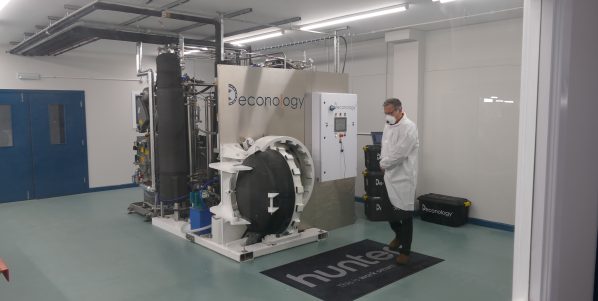
At Hunter, we offer Deconology® a CleanTECH which uses LCO₂+ decontamination technology, the most advanced tech of its kind in the UK and Europe. Traditional water-based laundry methods only remove 15-40% of contaminants from PPE leaving dangerous toxins behind, (based on studies from The Finnish Institute of Occupational Health). Hunter’s Deconology® system achieves over 99% removal of harmful substances such as PAHs and PFAS, while also protecting the integrity of the garments, (based on NFPA testing).
By combining scientific understanding with advanced decontamination systems, Deconology® addresses the fundamental requirement of removing harmful substances from firefighter PPE. Deconology® also supports environmental initiatives producing no wastewater or chemical runoff, operating at low temperatures to cut energy use and emissions and also reuses CO₂ in a circular process, gentler on PPE and to our planet.
The risks associated with fireground contamination are complex and evolving. As research advances, the sector must continue to engage openly with the science, challenge assumptions and improve operational practices. Projects such as InToxFIRE play an essential role in this progress. By examining how toxic chemicals interact with protective clothing, the research helps build the evidence needed to better understand firefighter exposure risks. At the same time, industry innovation must translate that knowledge into practical solutions that protect firefighters in real operational environments.
For Hunter, collaboration with researchers, fire services and industry partners is part of a wider responsibility, supporting our mission to protect those on whom society depends.
For any enquiries please contact sales@hunterapparelsolutions.com

Related Articles